ZENER CARDS · INTUITION AND CHANCE
◆
1
/
25
?
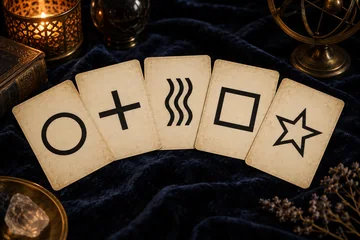
Choose a round of 10, 20 or 25 attempts with five possible symbols.
A perception game with five symbols that compares your choices with a hidden sequence. Practise attention and see how many matches you make in a round; no tarot knowledge is needed.
Choose 10, 20 or 25 attempts. On each turn, select the symbol you think will appear and continue until the round is complete. Every choice counts as one attempt; the same symbol may appear several times in a row.
The summary shows your matches alongside the 20% expected by chance. Exceeding that reference in one round can happen randomly. The result describes that game, not proof of extrasensory perception or a stable ability.