Online Numerology
Online Numerology — Explore the tools in this section and choose a reading for your question. Each page explains how it works and what the result includes.

Life Path Number
Day, month and year are reduced separately, then added and reduced again. Every step preserves 11, 22 and 33.
Personality Number
The consonants of the full name are added together. Vowels are excluded. Reduction preserves 11, 22 and 33.
Soul Urge Number
The vowels of the full name are added together. The total is reduced while preserving 11, 22 and 33, including intermediate steps.
Karmic Numerology
This variant adds consonants and preserves 11, 22 and 33. It shares the Personality calculation with a different symbolic reading...

Shadow Numerology
All letters are added and the expression number preserves 11, 22 and 33. For the shadow, reduce to 1–9 and subtract from 9. If th...
Predictive Numerology
Personal year: birth day and month plus the selected year, reduced to 1–9. Personal month: personal year plus the selected month,...
Numerology Compatibility
All letters in each name are added, preserving 11, 22 and 33. For comparison, both results are reduced to 1–9 and matched against...
Arithmancy
Name: all letters, vowels and consonants separately.

Your life cycles
Discover the four pinnacles of your birth date, their age ranges and your current stage.

Mirror hours and repeated numbers
Look up the time or number you noticed and explore a focused symbolic interpretation.

Home Numerology
Explore your house and apartment numbers, or compare two homes.

Birth Number Matrix
Your birth date builds a number grid. Explore its repetitions and spaces.

Name and Signature Numerology
Compare up to three written versions of your name, alias or professional signature.
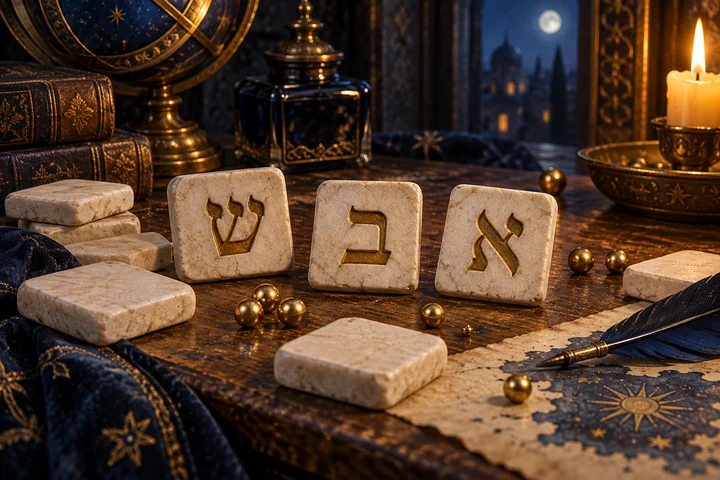
Gematria · Words and Numbers
Explore Hebrew letter values and compare two words using a guided keyboard.

Your personal magic square
Enter a date and create a grid of 16 numbers. Explore how its rows, columns and main diagonals all have the same sum.

Tantric Numerology · Your five numbers
Soul, karma, gift, destiny and path: five aspects of your birth date.

Chaldean name numerology
Discover your name’s compound total and root using Cheiro’s method.

The cycles of your name
Explore active letters, your Essence cycle and the changes between birthdays.
Pythagorean numerology starts from an old intuition: each letter of the alphabet corresponds to a number from 1 to 9, and the sum of those numbers — applied to a person's name and birth date — reveals character traits, deep motivations and a "life path". The assignment is simple: A=1, B=2, C=3… through I=9, then J=1 again, and so on.
The system is attributed to Pythagoras (6th century BC), although modern numerology as we know it is actually the work of L. Dow Balliett, American writer of the early 20th century. At Tarotsim we offer eight free numerological calculations with AI interpretation.
What each number means
- 1 — initiative, leadership, individuality.
- 2 — diplomacy, partnership, sensitivity.
- 3 — expression, creativity, communication.
- 4 — stability, work, order.
- 5 — freedom, adventure, change.
- 6 — harmony, care, family.
- 7 — analysis, spirituality, introspection.
- 8 — power, materialization, abundance.
- 9 — compassion, transcendence, cycle closure.
There are also master numbers — 11, 22, 33 — which in some currents are not reduced, considered high-frequency vibrations.
How to calculate your Life Path
Add day, month, and year of birth, reducing the result to a single digit. Example: 14/03/1985 → 1+4+0+3+1+9+8+5 = 31 → 3+1 = 4. Your Life Path is 4 — a life oriented toward building, stability, and disciplined work.
Frequently asked questions
Does numerology have a scientific basis?
No. There's no empirical evidence that the sum of name or birth date numbers influences personality. Numerology works as a symbolic system — useful for self-reflection, not as a science of personality.
Did Pythagoras really create numerology?
Pythagoras and his school believed that "everything is number". Modern numerology — with the letter-number equivalence table — was systematized by L. Dow Balliett in "The Day of Wisdom According to Number Vibration" (1903).
Should I use my birth name or current name?
Schools diverge. Purists use the full birth name; reformists use the name by which the person is currently known. If you changed names, calculate both and compare.